

Recent reports from Sylvera, MSCI and the World Bank suggest that demand for carbon credits remains strong. What has changed is how buyers evaluate climate assets.
For years, the voluntary carbon market was often assessed through a single indicator: transaction volume.
When trading activity slowed, many concluded that the market was losing momentum. When volumes increased, confidence appeared to return.
Today, that interpretation is no longer sufficient.
The latest analyses published by Sylvera, MSCI and the World Bank point to a more significant transformation. Demand for carbon credits has not disappeared. Instead, corporate buyers and investors have become considerably more selective, placing greater emphasis on the quality, governance and credibility of the projects they support.
The market is no longer purchasing carbon alone.
It is purchasing confidence.
Capital Is Moving Toward Higher Integrity Assets
Sylvera’s Carbon Data Snapshot Q2 2026 provides compelling evidence of this market evolution.
Although retirement volumes remained relatively stable over the last four years, the financial value of the voluntary carbon market continued to increase.
Figure 1. Evolution of retirement volumes, market value and average carbon credit prices between Q2 2023 and Q2 2026.
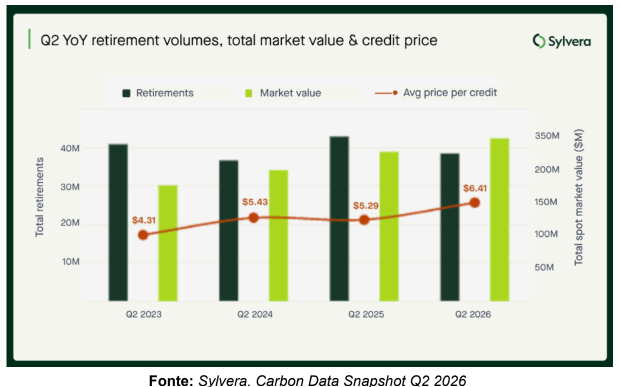
The most significant trend lies in pricing.
Average carbon credit prices increased from US$4.31 in the second quarter of 2023 to US$6.41 in Q2 2026, representing a price increase of nearly 49%.
During the same period, the estimated value of the spot market almost doubled, increasing from approximately US$170 million to more than US$350 million.
Another important indicator illustrates how rapidly quality standards are reshaping the market.
According to Sylvera, carbon credits accredited under the Core Carbon Principles (CCP), developed by the Integrity Council for the Voluntary Carbon Market (ICVCM), represented less than 3% of new issuances in 2023. By Q2 2026, that share had increased to 27.5% of all newly issued credits, highlighting a clear transition toward higher integrity supply.
The conclusion is straightforward.
Buyers continue to invest in carbon credits, but they are increasingly willing to pay a premium for projects that demonstrate stronger environmental and technical credibility.
Carbon Alone Is No Longer Enough
MSCI reaches a remarkably similar conclusion in its Voluntary Carbon Market in Review Q2 2026.
The report suggests that the voluntary market has entered a new phase of maturity.
Corporate buyers now conduct significantly more comprehensive due diligence before acquiring carbon credits. Governance structures, project transparency, methodological robustness, traceability, legal certainty and strong Monitoring, Reporting and Verification (MRV) systems have become central elements of investment decisions.
Carbon volumes remain important.
However, buyers increasingly seek to understand how each credit was generated, which methodology was applied, how monitoring is performed, who conducted the independent verification and how legal and operational risks are managed throughout the project’s lifecycle.
In today’s market, credibility has become as important as carbon.
The World Bank Identifies the Same Market Direction
The State and Trends of Carbon Pricing 2026, published by the World Bank, reinforces this perspective.
According to the report, there are currently 80 carbon pricing instruments operating worldwide, including emissions trading systems and carbon taxes, covering approximately 28% of global greenhouse gas emissions.
The report also highlights the growing interaction between compliance and voluntary carbon markets, while recognising that high integrity carbon credits can play an increasingly important role in mobilising private investment for nature based solutions and other climate mitigation activities.
Another important conclusion concerns forest conservation.
The World Bank recognises that well governed voluntary carbon markets have significant potential to channel private capital into forest protection, particularly in countries with extensive natural assets.
Once again, the message aligns closely with the conclusions reached by Sylvera and MSCI.
Future market growth will depend less on the number of available credits and increasingly on the confidence buyers place in those assets.
A New Opportunity for High Integrity Forest Conservation Projects
This market evolution creates an important opportunity for privately developed forest conservation projects built upon rigorous methodologies and internationally recognised certification standards.
For many years, forest carbon projects were frequently assessed as a homogeneous asset class, regardless of substantial differences in governance, technical quality or legal robustness.
That perception is changing.
As buyers strengthen their due diligence processes, projects capable of demonstrating additionality, legal certainty, continuous monitoring, independent third party verification, traceability and measurable environmental and social outcomes are becoming increasingly differentiated.
One issue deserves particular attention.
Both the World Bank and MSCI identify land tenure and legal certainty as increasingly relevant components of project quality. Recent years have shown that several forest carbon projects have faced suspension or market scrutiny due to unresolved land ownership disputes and uncertainty regarding carbon rights.
Responding to these challenges, newer certification frameworks have incorporated stronger legal safeguards into their project development processes.
The Lux Carbon Standard (LuxCS) provides one such example.
Under its certification framework, projects cannot advance while uncertainties remain regarding land ownership or legal rights over the project area. Furthermore, project validation and verification are conducted through independent third party auditors, providing an additional layer of transparency and credibility.
This reflects exactly what an increasingly sophisticated voluntary carbon market is demanding: high integrity projects are no longer competing primarily on price.
They are competing on trust.
369 EcoCredits’ Perspective
At 369 EcoCredits, we see these market developments as confirmation of a long term trend rather than a short term market adjustment.
From the beginning, our strategy has focused on identifying, structuring and commercialising climate assets capable of meeting the evolving expectations of global carbon markets, rather than simply following prevailing market practices.
Our portfolio includes high integrity forest conservation projects across the Amazon and Atlantic Forest biomes, alongside renewable energy carbon credits, all selected under principles of environmental integrity, traceability, legal certainty, methodological consistency and long term value creation.
The conclusions published independently by Sylvera, MSCI and the World Bank all point in the same direction.
The voluntary carbon market is not shrinking, it is maturing.
And in mature markets, high integrity is no longer a competitive advantage.
It becomes the minimum requirement for long term value creation.