

The latest figures released by the World Bank help demonstrate that carbon has definitively moved beyond being merely an environmental issue. According to the State and Trends of Carbon Pricing 2026 report, carbon pricing mechanisms generated more than US$107 billion in global revenue in 2025, while approximately 30% of global emissions are now covered by some form of pricing instrument, whether through regulated markets or carbon taxes.
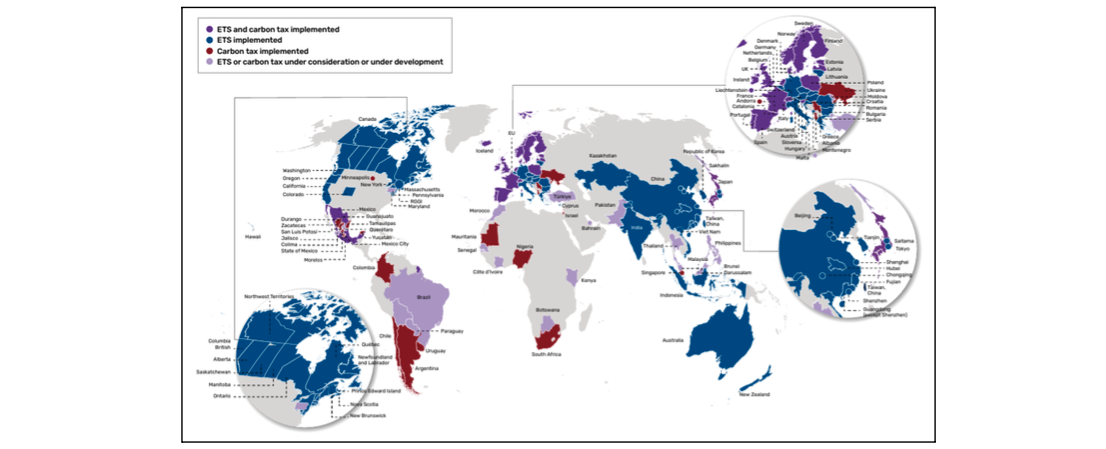
The global expansion of these instruments can be observed in the image below, published in the World Bank report itself, which illustrates the distribution of regulated carbon markets and carbon taxation mechanisms already implemented or under development around the world.
The map demonstrates that carbon pricing has moved beyond an isolated discussion and has become integrated into economic and industrial policies across multiple regions of the planet.
FIGURE 1 — Carbon pricing mechanisms implemented or under development worldwide.
.
.
.
.
Source: World Bank — State and Trends of Carbon Pricing 2026.
.
.
.
.
CARBON IS BECOMING PART OF GLOBAL ECONOMIC LOGIC
Perhaps the most relevant figure is not simply the financial volume involved, but what it represents: governments, investors, and major supply chains have begun incorporating carbon emissions into global economic logic.
Carbon is starting to occupy a position similar to other strategic variables that shape business competitiveness, market access, and investment attraction. What only a few years ago was treated as a complementary sustainability agenda now influences long-term industrial, commercial, and financial decisions.
And this profoundly changes the discussion surrounding the carbon market. The international debate is no longer centered on whether this market should exist. The question now is different: which climate assets will be prepared to meet the new level of global expectations?
.
.
.
.
THE VOLUNTARY MARKET CONTINUES TO PLAY A CENTRAL ROLE
The World Bank report itself offers important reflections on this topic, particularly regarding the voluntary carbon market.
In recent years, part of the market interpreted the advancement of regulated markets and Article 6 of the Paris Agreement as a potential weakening of voluntary markets.
The report points in a different direction.
The perspective presented is one of coexistence and complementarity between these mechanisms.
Regulated markets tend to advance through national targets and mandatory sectors, while the voluntary market continues to play a fundamental role in financing nature-based solutions, forest conservation, carbon removal, territorial projects, and climate innovation initiatives, particularly in developing countries.
This actually means that the voluntary market does not disappear with regulatory progress. Instead, it benefits as it absorbs new trends, resulting in a natural maturation of its mechanisms.
The report recognizes that the sector has undergone a period of intense scrutiny related to credit quality, additionality, traceability, and methodological robustness.
However, the most important point is that the World Bank does not interpret this process as a sign of structural weakness.
On the contrary.
The understanding is that this process represents the natural evolution of a market gaining economic and institutional relevance on a global scale.
MATURE MARKETS REQUIRE TRUST. AND TRUST REQUIRES INTEGRITY.
.
.
.
.
THE MARKET IS BEGINNING TO DISTINGUISH BETWEEN COMMODITY CARBON AND PREMIUM CARBON
Perhaps one of the report’s most important insights is the perception that market growth does not automatically mean appreciation for all credits.
The document shows that even in a scenario of pressure on average voluntary market prices, certain assets continue to command premium valuations.
This is particularly true for credits associated with robust forest projects, carbon removals, initiatives with greater traceability, and projects aligned with stricter governance and monitoring standards.
This demonstrates an important shift: the market is beginning to separate commodity carbon from premium carbon.
For a long time, the focus was concentrated on volume.
How many tons could be generated.
What was the potential size of the market.
Now the rule is gradually changing toward quality, permanence, transparency, legal certainty, and the ability to withstand increasing international scrutiny.
This movement helps explain why corporate buyers have adopted increasingly sophisticated criteria for acquiring credits.
Global companies are no longer seeking emissions compensation alone.
They are seeking climate assets capable of withstanding audits, reputational analysis, future regulatory requirements, and long-term climate commitments.
.
.

.
.
.
CO-BENEFITS ARE BECOMING A STRATEGIC DIFFERENTIATOR.
The report also reinforces another highly relevant point: the growing role of project co-benefits.
Issues such as biodiversity conservation, local income generation, productive inclusion, territorial development, and community strengthening are becoming increasingly important within climate asset valuation mechanisms.
However, market maturation is also changing how these impacts are evaluated.
Co-benefits are no longer merely narrative elements.
They now require verifiable metrics, continuous monitoring, and an objective ability to demonstrate results.
In other words, social and environmental impacts are expected to meet the same level of rigor applied to the carbon asset itself.
This trend is likely to favor more structured projects, with greater technical depth, robust governance, and consistent monitoring capabilities.
THE NEXT SCARCITY MAY NOT BE VOLUME. IT MAY BE TRUSTWORTHY ASSETS.
.
.
.
.
BRAZIL’S STRATEGIC POSITION IN THE NEW CLIMATE ECONOMY
At the same time, the report reinforces an extremely relevant perspective for countries such as Brazil.
A large portion of the projects required to enable the global climate transition will likely not be financed solely through regulated markets.
Nature-based solutions, forest conservation, environmental restoration, and complex territorial projects will continue to depend heavily on capital mobilized through the voluntary market.
This places Brazil in a strategic position.
Few countries possess Brazil’s combination of forest potential, biodiversity, environmental asset generation capacity, and opportunities to develop climate solutions at scale.
However, there is a central point in this equation:
Brazil’s potential will not be defined solely by its ability to generate credits, but by its ability to generate international trust.
.
.
.
.
THE FUTURE WILL BE DEFINED BY QUALITY
The next phase of the global carbon market is likely to be characterized less by a scarcity of volume and more by a scarcity of reliable assets.
And perhaps that is the main reflection brought by the World Bank report.
The future of the market will not be defined solely by the expansion of global demand or the growth of regulatory mechanisms.
It will be defined by the quality of the assets capable of surviving the next level of international scrutiny.
This is precisely the context in which 369 EcoCredits Solutions positions itself.
We understand that the next phase of the global carbon market will be defined less by volume and more by quality, credibility, and the ability to adapt to new international requirements.
For this reason, we operate with a focus on integrity, traceability, and the structuring of assets aligned with the new global climate economy, connecting buyers with solutions that combine technical robustness, security, and long-term strategic vision.
In a market that is becoming increasingly sophisticated, we believe trust will cease to be a differentiator and become a prerequisite.
Because the world has already started putting a price on carbon. The question now is: who will truly be prepared?