

For years, Brazil’s regulated carbon market was treated as an institutional development agenda. The topic advanced through legislative proposals, public consultations, and technical discussions, yet remained distant from the practical reality of most companies. However, recent developments show that this scenario is changing.
With the approval of Law No. 15,042/2024, which established the Brazilian Emissions Trading System (SBCE), and the federal government’s recent progress in defining the system’s sectoral coverage, Brazil’s regulated carbon market is beginning to take shape.
More than a regulatory change, we are facing a transformation that is likely to influence competitiveness, market access, investment decisions, and corporate strategy over the coming years.
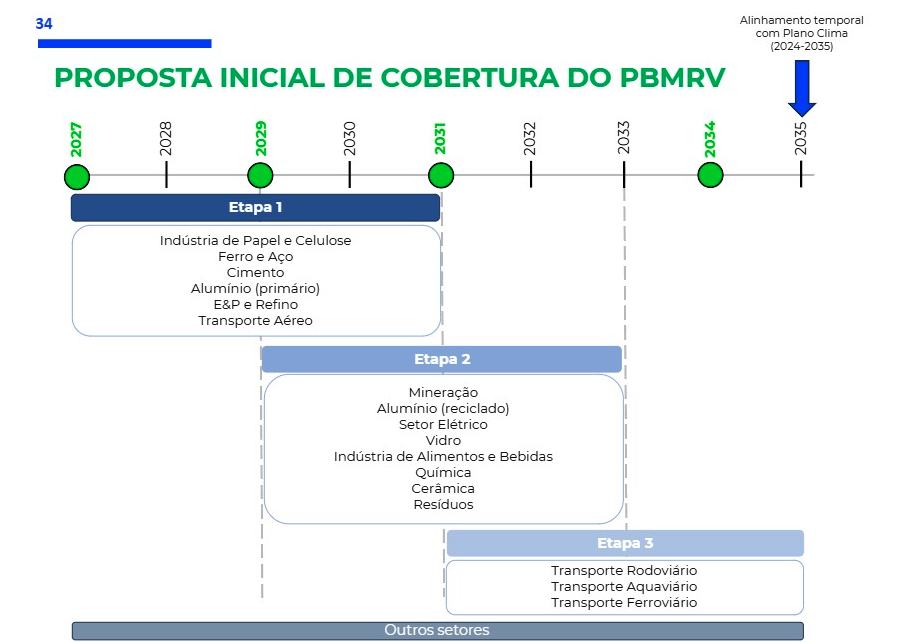
In recent weeks, the Ministry of Finance, through the Special Secretariat for the Carbon Market (SEMC), presented the preliminary proposal for the SBCE’s sectoral coverage, defining a gradual implementation process for sectors that will be required to monitor, report, and verify their emissions.
The first phase, scheduled for 2027, includes pulp and paper, iron and steel, cement, primary aluminum, oil and gas exploration and production, refining, and aviation. Future phases are expected to incorporate sectors such as mining, power generation, chemicals, glass, food and beverages, ceramics, waste management, and various transportation modes.
The selection of these sectors is not accidental.
FIGURE 1 — Initial sector coverage proposal
.
.
.
.
Source: Ministry of Finance (2026). Preliminary proposal for sectoral coverage of the Brazilian regulated carbon market (SBCE).
.
.
.
.
THE FIRST SECTORS INCLUDED ARE STRATEGIC FOR BRAZIL’S COMPETITIVENESS.
We are talking about some of the most important sectors of the Brazilian economy, both in terms of emissions intensity and economic significance, as well as their exposure to international markets.
The oil and gas sector, for example, represents approximately 17% of Brazil’s industrial GDP, generates around 1.6 million direct and indirect jobs, and accounted for more than US$57 billion in exports in 2024 alone.
Brazil currently produces more than 4.3 million barrels of oil and gas per day, consolidating its position as one of the world’s leading energy producers.
The steel industry also plays a strategic role.
Brazil ranks among the world’s largest steel producers, with annual production close to 34 million tons, exports to more than 100 countries, and a value chain that directly employs over 117,000 workers.
In 2024 alone, the sector recorded a trade surplus of US$1.8 billion.
The pulp and paper industry presents equally impressive numbers.
Brazil achieved record production and exports in 2025, reaching 29.4 million tons of pulp produced and 20.7 million tons exported.
The sector has consolidated itself as one of the country’s leading export industries, supported by billions in investments and one of the most competitive forestry bases in the world.
In other words, the first sectors entering the SBCE’s scope are directly connected to Brazil’s international competitiveness.
And that is extremely important.
THE QUESTION IS NO LONGER WHEN THE MARKET WILL ARRIVE. IT IS HOW PREPARED COMPANIES WILL BE.
.
.
.
.
THIS IS A STRATEGIC PREPARATION PHASE
Perhaps that is exactly why the most important question for many companies should not be when the regulated market will become fully operational.
The more relevant question is: What needs to be done before that happens?
International experience shows that organizations that wait for final regulation before beginning their preparation usually face higher adaptation costs, reduced strategic flexibility, and greater difficulty capturing opportunities.
This happened with Brazil’s LGPD.
It happened with various ESG requirements.
And it is already beginning to happen with carbon-related topics such as the Carbon Border Adjustment Mechanism (CBAM), which recently became mandatory.
The SBCE’s own structure indicates that the coming years will be dedicated to building the system’s technical infrastructure, including emissions monitoring, reporting, and verification, the development of national registries, and the definition of market operating parameters.
This means that the current moment should not be interpreted as a waiting phase.
It should be seen as a strategic preparation phase.
Companies that understand their emissions, maintain robust greenhouse gas (GHG) inventories, assess their climate risks, and begin structuring decarbonization plans are likely to be better positioned when regulatory requirements become fully established.
.
.

.
.
REGULATED AND VOLUNTARY MARKETS ARE NOT COMPETITORS
There is another highly relevant point that deserves attention.
The advancement of Brazil’s regulated market does not mean the weakening of the voluntary carbon market.
In fact, international experience points precisely toward a complementary relationship.
Several regulated systems already incorporate offset mechanisms based on carbon credits.
California’s emissions trading system, considered one of the global references in carbon trading, allows the use of offsets generated from greenhouse gas mitigation projects to partially fulfill regulatory obligations.
Other international markets also utilize eligible credits under specific integrity, traceability, and additionality criteria.
In Brazil’s case, the SBCE legal framework itself already provides for the existence of Verified Emission Reduction or Removal Certificates (CRVEs), signaling a potential future integration between assets generated in the voluntary market and the regulated market’s dynamics.
Regulation will still define limits, criteria, and eligibility requirements.
However, the prospect of interoperability between the two markets is already embedded within the system’s architecture.
This discussion is particularly important because regulated and voluntary markets are often presented as competitors.
That should not be taken as an absolute truth.
International trends indicate the opposite.
THE FUTURE POINTS TOWARD CONVERGENCE, NOT COMPETITION.
.
.
.
.
HIGH-INTEGRITY CREDITS ARE GAINING STRATEGIC VALUE.
Regulated markets primarily focus on large emitters and mandatory emissions reduction targets.
Voluntary markets continue to play a fundamental role in financing forest projects, environmental conservation, restoration, bioenergy, biogas, methane capture, and nature-based solutions.
Furthermore, as quality requirements become more rigorous, there is growing recognition that high-integrity voluntary credits may occupy a strategic position within the new climate economy.
Competitive advantage is becoming less about volume and more about credibility.
Traceability, methodological robustness, land tenure security, continuous monitoring, and the ability to demonstrate verifiable impacts are becoming increasingly important attributes for buyers, investors, and regulated markets.
.
.
.
.
BRAZIL’S POTENTIAL WILL BE MEASURED BY TRUST
This is particularly important for Brazil.
Few countries possess such a favorable combination of forest potential, a relatively clean energy matrix, opportunities in bioenergy, biogas production capacity, restoration potential, and the ability to generate environmental assets at scale.
But there is a central point in this equation:
Brazil’s potential will not be defined solely by the number of credits it can generate.
It will be defined by its ability to generate trust.
The international market is becoming increasingly selective.
Companies, investors, and governments are no longer searching only for tons of carbon.
They are seeking assets capable of withstanding growing regulatory, reputational, and financial scrutiny.
.
.
.
.
CLIMATE STRATEGY CAN BECOME A COMPETITIVE ADVANTAGE
This is precisely the context in which 369 EcoCredits positions itself.
We understand that the evolution of the SBCE and the global carbon market will be marked by the convergence of regulated and voluntary markets, with increasing appreciation for assets capable of meeting higher standards of integrity, traceability, and technical robustness.
For this reason, we operate by connecting buyers to solutions aligned with the requirements of the new climate economy, always focusing on quality, credibility, and long-term strategic vision.
Because the challenge for Brazilian companies will not simply be complying with future regulations—it will be transforming climate strategy into competitive advantage.
And that preparation should begin before all the rules are finalized.